For the complete documentation index, see llms.txt. Markdown versions of all docs pages are available by appending .md to any docs URL.
Non-agentic HTTP traffic
Verified Code examples on this page have been automatically tested and verified.Route HTTP traffic to a non-agentic backend such as httpbin with the agentgateway binary.
Use the agentgateway binary to route HTTP traffic to a simple backend (httpbin) running locally.
    flowchart LR
    A[client] -->|localhost:3000| B[agentgateway]
    B --> C[httpbin]
- The client sends requests to agentgateway on port 3000.
- Agentgateway forwards the requests to the httpbin backend based on the route and backend configuration.
- Httpbin responds, and agentgateway returns the response back to the client.
Before you begin
Install the agentgateway binary.
curl -sL https://agentgateway.dev/install | bashInstall Docker to run httpbin.
Steps
Step 1: Start httpbin in Docker
Run the httpbin image so it listens on port 80 inside the container. Map it to a host port such as 8000 so that agentgateway can reach it.
docker run --rm -d -p 8000:80 --name httpbin kennethreitz/httpbinVerify that httpbin responds.
curl -s http://localhost:8000/headers | head -20 || trueExample output:
{
  "headers": {
    "Accept": "*/*",
    "Host": "localhost:8000",
    "User-Agent": "curl/8.7.1"
  }
}
Step 2: Configure agentgateway to route to httpbin
You add the listener and route from the UI, so you can start agentgateway with an empty config file.
In a separate terminal, start agentgateway.
echo '{}' > config.yaml
agentgateway -f config.yaml
Open the agentgateway UI. On the Gateway Overview, find the Traffic row and click Enable Traffic.
Add a bind and listener.
- In the Traffic section of the navigation menu, click Listeners.
- Click Add bind, enter
3000for the Port, and click Save bind. - Click Add listener, keep the defaults (HTTP, hostname
*), and save the listener.
Add a route to httpbin.
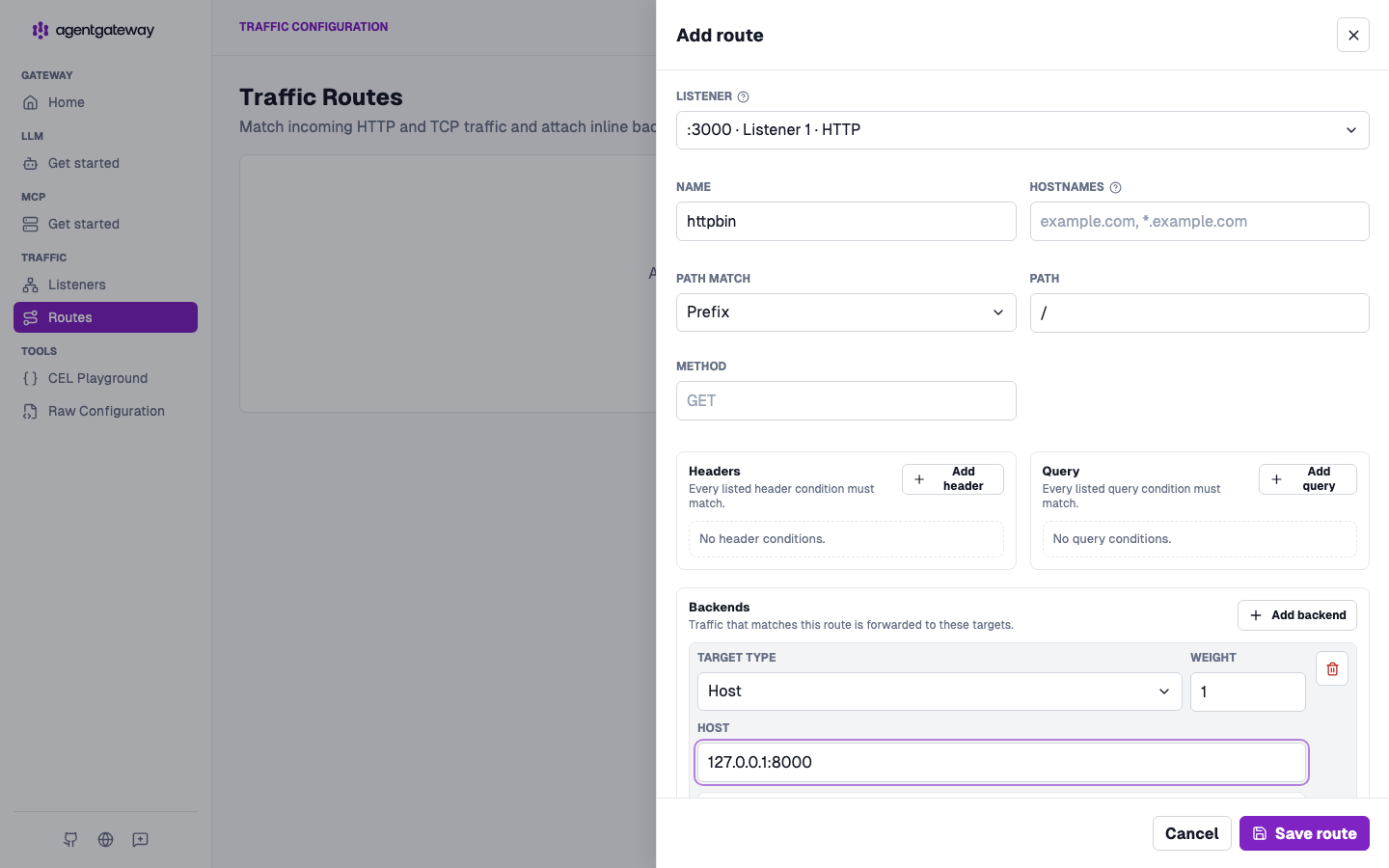
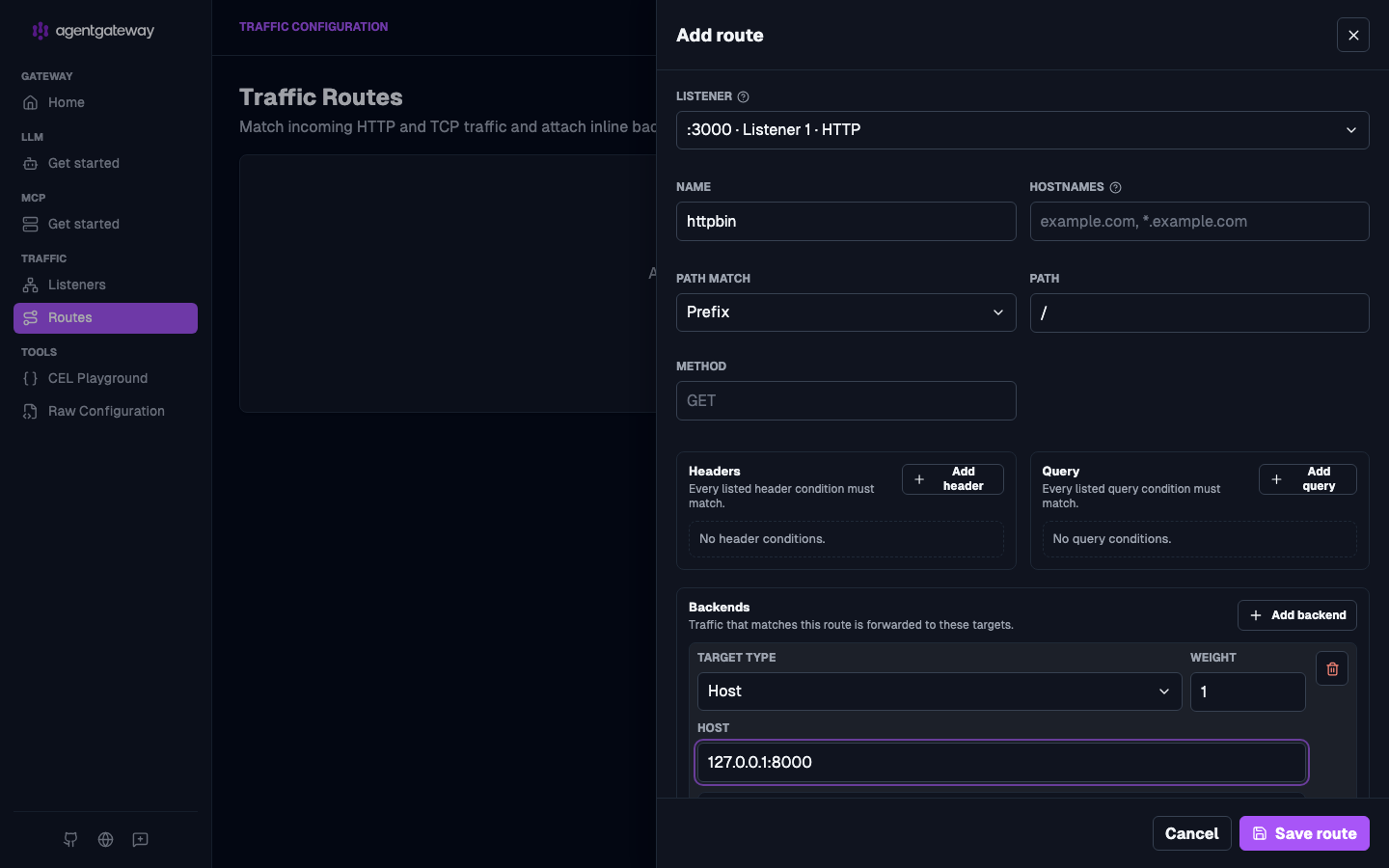
- Click Routes, and then click Add route.
- For the Listener, select the
:3000listener you created. - Under Backends, click Add backend, keep the Host target type, and enter
127.0.0.1:8000for the host. - Click Save route.
Step 3: Send a request through agentgateway
Send a request to agentgateway on port 3000. Agentgateway forwards it to httpbin; the response is returned to you.
curl -i http://localhost:3000/headersExample response (status and headers):
HTTP/1.1 200 OK
content-type: application/json
...
Example JSON body:
{
  "headers": {
    "Accept": "*/*",
    "Host": "localhost:3000",
    "User-Agent": "curl/8.7.1"
  }
}
You can try other httpbin endpoints through agentgateway, such as the following.
curl -s http://localhost:3000/get
curl -s http://localhost:3000/post -X POST -H "Content-Type: application/json" -d '{"key":"value"}'
Step 4 (Optional): Stop httpbin
When you are done, stop and remove the httpbin container.
docker stop httpbin